
If you’ve ever spent a Saturday afternoon carefully arranging your open shelves only to step back and think, why does this still look like a garage sale you’re not alone. Open shelves are one of those things that look effortlessly beautiful in every Pinterest photo and absolutely chaotic in real life. And honestly? It’s not your stuff that’s the problem. It’s the approach.
Most people treat open shelves like extra storage with a prettier face. They’re not. They’re more like a curated display, and the moment you start treating them that way, everything changes. This post breaks down exactly how to style open shelves without clutter and more importantly, how to keep them looking good without having to redo them every week.
The Mistakes That Are Making Your Shelves Look Cluttered
You’re Keeping Too Much Stuff on Them
Here’s the thing — open shelves should hold less than you think. A common instinct is to fill every inch of space, because empty space feels wasteful. But negative space is actually doing the heavy lifting. It gives your eye a place to rest. Without it, even beautiful objects start competing with each other and the whole thing reads as noise.
A good rule: aim to leave about 30–40% of your shelf space visually “open.” That might mean a single vase on one shelf instead of three. It feels wrong at first, but it photographs beautifully and looks intentional in person.
Everything Is the Same Height
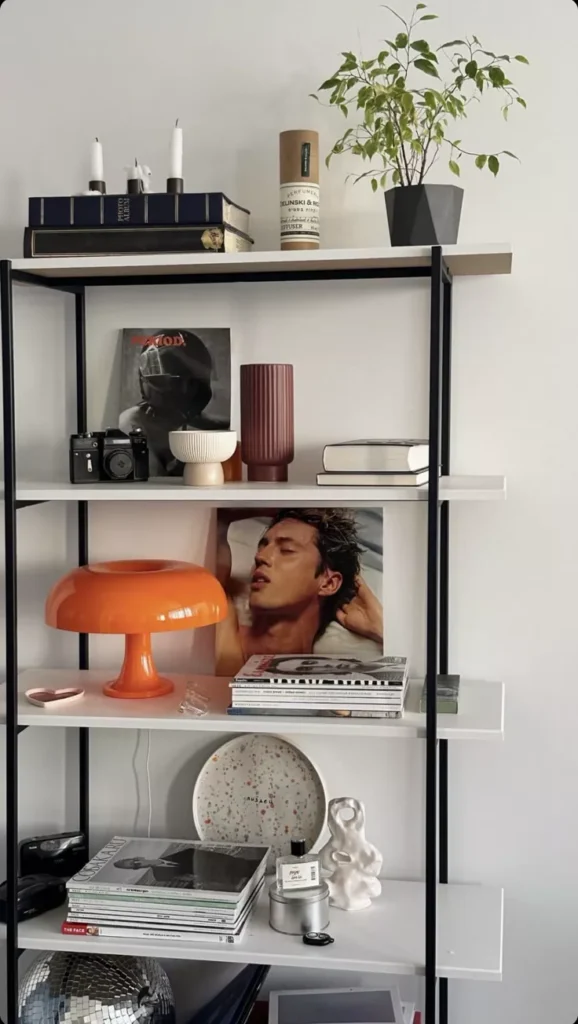
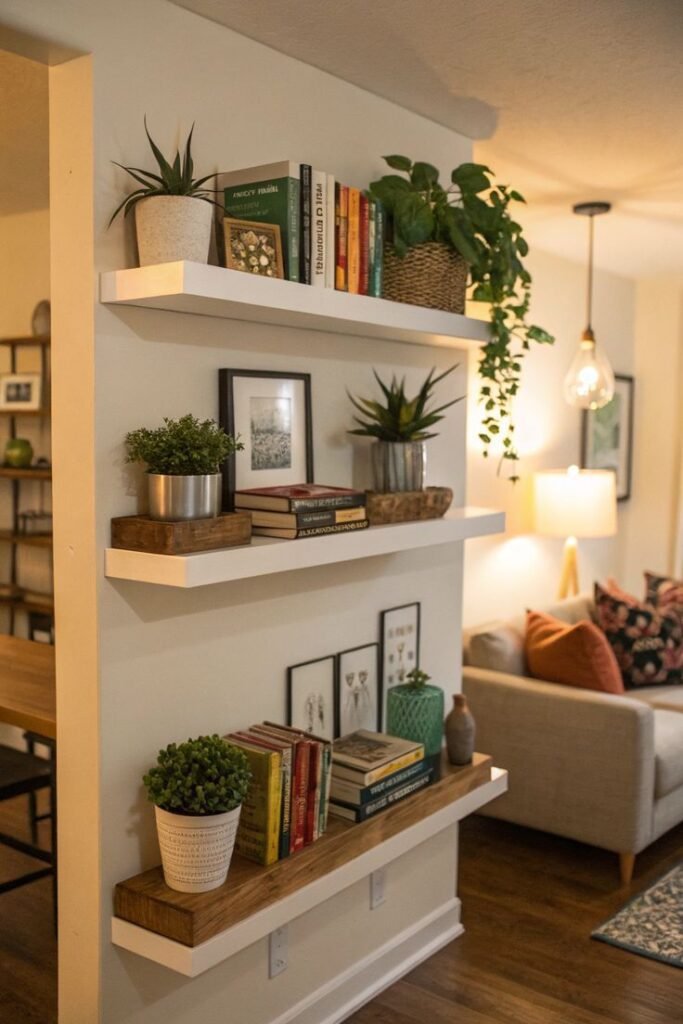
When every item on a shelf sits at the same eye level, the shelf looks flat and forgettable. Your eye needs movement — something tall, something low, something in between. This is called visual rhythm, and it’s the difference between a shelf that looks designed versus one that looks like items were just placed there.
Think about it like a skyline. A city with buildings all the same height looks boring. Add variety, and suddenly it’s interesting.
You’re Mixing Too Many Colors
Colorful shelves can absolutely work, but most people go wrong by using too many accent colors with no unifying thread. The result is chaos, even if each individual item is pretty. Before you start styling, pick a palette — usually two to three colors max — and let everything else be neutral. That might mean swapping out a bright orange candle for a terracotta one, or replacing a navy blue book with a white one. Small swaps, big difference.
The Principles That Actually Work
Edit First, Style Later
Most people style open shelves by adding things. What actually works is starting by removing things. Take everything off. Lay it on the floor or a table. Now look at what you actually have. You’ll probably notice that half of it doesn’t need to be there — old mail, random knickknacks that don’t mean anything to you, duplicate items.
Keep only what you genuinely like or what serves a purpose you actually use. Everything else finds a home in a cabinet or a donation bag. This sounds basic, but most people skip this step and try to style around the clutter. It never works.
Group Items in Odd Numbers
This is a design principle that’s been around forever, and it holds up. Groups of three or five just look better than groups of two or four. The brain reads even numbers as complete and symmetrical, which is fine for some things, but on a shelf it can feel stiff. Odd groupings feel more natural and collected over time.
So instead of two matching candleholders on their own, add a small plant or a book between them. Now it’s a vignette, not just two objects sitting next to each other.
Use Books as Building Blocks, Not Just Filler
Books are underrated in shelf styling. They add color, texture, and height — all at once. But most people just line them up spine-out in a row and call it done. Try mixing it up: stack a few horizontally and use them as a riser for a small object. Turn a few spine-inward (pages facing out) for a neutral, cohesive look in sections where the colors are too chaotic. It changes the whole vibe without spending a dime.
A Step-by-Step Approach to Styling Your Shelves
Step 1: Decide What the Shelf Is Actually For
Before you pick a single object, decide if this shelf is primarily decorative or primarily functional. A shelf in your home office is going to operate differently than one in your living room. If it’s functional, lean into it — styled storage like labeled baskets or pretty bins can look intentional. If it’s decorative, then anything that’s purely utilitarian needs to go somewhere else.
Step 2: Anchor Each Shelf With One Statement Piece
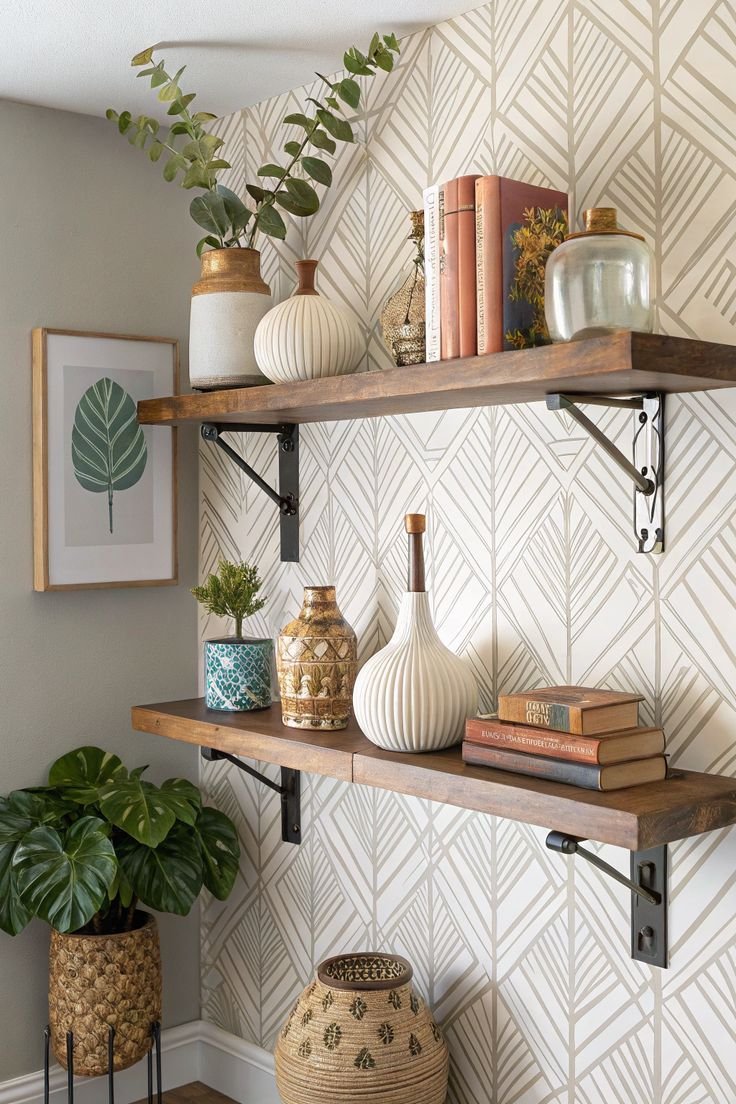
Start each shelf with one “anchor” — something larger that sets the tone. This could be a tall vase, a piece of art leaned against the wall, a larger plant, or a substantial decorative object. Everything else on that shelf should complement the anchor, not compete with it.
This is why shelves styled by designers always look cohesive. They’re not just randomly placing objects — they’re building a hierarchy.
Step 3: Add Texture Before You Add Color
Once your anchor is in place, bring in texture before you reach for colorful accents. Woven baskets, ceramic pieces, linen-bound books, wooden objects, dried botanicals — these add visual interest without adding visual noise. Texture reads as sophisticated in a way that a collection of brightly colored items rarely does.
Once you have your textures in place, then layer in one or two accent colors intentionally.
Step 4: Step Back (Literally)
After each addition, step back at least six to eight feet and look. We tend to style shelves up close, which means we’re focused on the details. But people experience shelves from across a room. What looks fine up close might look crowded from a distance, or the opposite — you might think something is visible but it disappears from afar.
Adjust based on the full-room view, not the up-close view.
Step 5: Live With It Before You Finalize
Don’t declare your shelves “done” the same day you style them. Live with them for a few days. You’ll notice what bothers you, what you keep bumping into, what feels off after the initial excitement wears off. This step saves you from constant restyling because you take the time to actually evaluate instead of just react.
Practical Tips That Don’t Get Talked About Enough
Contain small items. Loose items — jewelry, pens, small figurines — look messy no matter how nice they are. Put them in a small tray, bowl, or box. Instant upgrade.
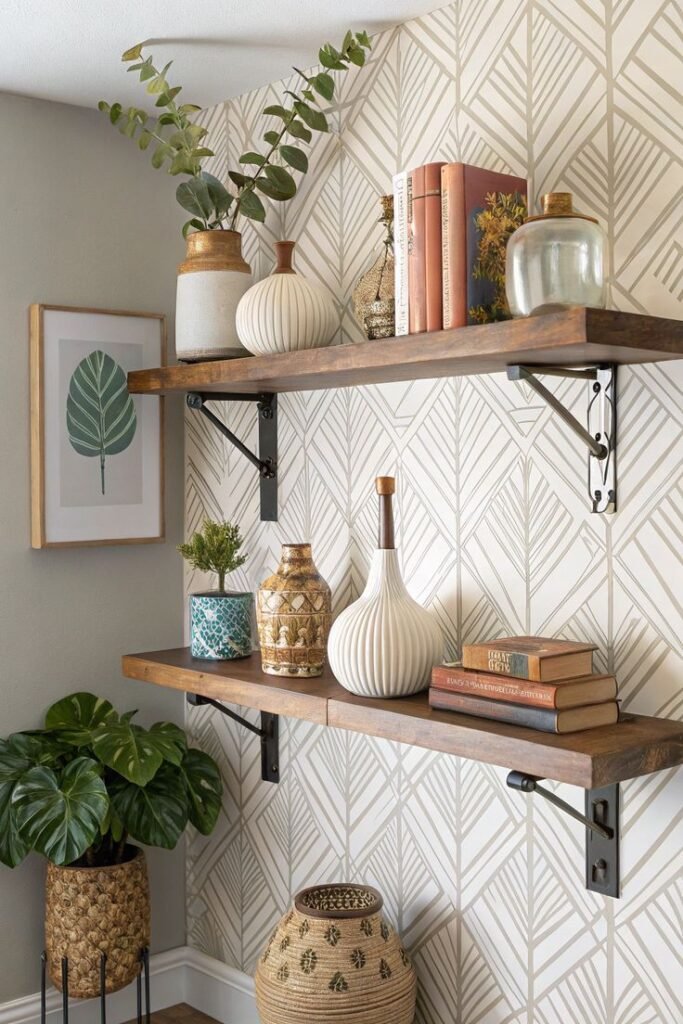
Don’t forget the back wall. Painting the back of your shelves a contrasting color, or adding peel-and-stick wallpaper, creates depth and makes objects pop. It’s one of the highest-impact, lowest-cost things you can do.
Vary your materials. Shelves that only have ceramic and glass look sterile. Mix in wood, metal, fabric, and organic elements like dried grasses or plants. The contrast between materials is what makes a shelf feel layered and real.
Refresh seasonally, not constantly. One of the reasons shelves start looking cluttered again is that people keep adding things without removing anything. Commit to seasonal edits — what goes on the shelf in spring doesn’t all stay through winter. Swapping a few key pieces keeps things looking intentional without a full redo.
Resist the urge to display everything you love. Just because you love something doesn’t mean it needs to be on display. A shelf isn’t a collection room. If you have too many things you love, rotate them. Store half, display half, swap every few months.
Keeping It That Way (The Part Nobody Talks About)
Styling open shelves is actually the easier part. Keeping them from going back to clutter is the real challenge. The main reason shelves get cluttered again is that they become a drop zone — you set something down “just for now” and it lives there forever.
The fix is simple but requires a habit shift: if you pick something up from your shelf, it goes back in the exact same spot. And anything that wasn’t on the shelf doesn’t go on the shelf without a deliberate decision. Treat your shelves like you treat a guest room — it doesn’t just absorb random items because it has space.
A quick five-minute reset once a week is enough to maintain a styled shelf. It’s not about perfection, it’s about intention.
Final Thoughts
Styling open shelves without clutter really comes down to one core idea: less is doing more than you think. The empty space, the breathing room, the intentional groupings, none of that happens by accident. It takes editing more than adding, and stepping back more than leaning in.
Start with what you already have. Pull everything off, keep only what you actually love, and build back up slowly with the principles above. You don’t need new things you probably just need fewer things in the right arrangement.
Give it a try this weekend. Even just clearing one shelf and restyling it with these ideas will show you what a difference a more intentional approach makes. Once you see it, you won’t go back to the old way.